

AI Search Visibility in Canadian Manufacturing: Findings from Ten Audits
We Audited Ten Canadian Manufacturers for AI Visibility. We Expected Gaps. We Found Silence.
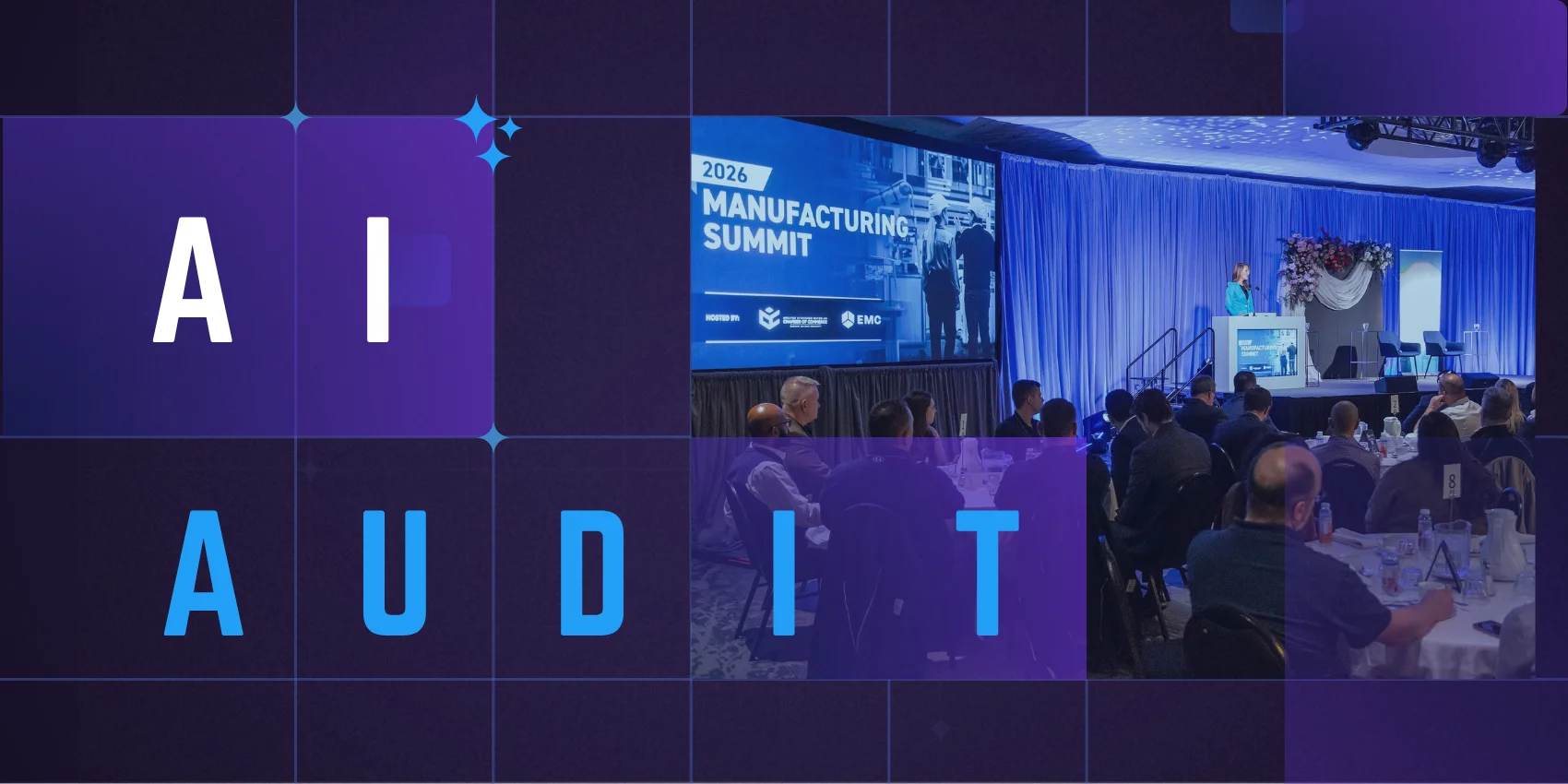
Our anonymized findings from ten AI Shortlist Readiness Audits, conducted following the May 2026 Greater Kitchener Waterloo Chamber of Commerce Manufacturing Summit. In a season of tariffs, tightening borders, and AI-assembled shortlists, no business reached the "established" band of our assessment.
Key findings: The cohort mean is 36.1 out of 100, the median 33. Five of ten declared zero machine-readable facts; to the AI assembling candidate lists, half the cohort does not exist. The cohort's only closed verification loop came from a single published certificate number. The good news: the gap is structural, and structure can be solved for.
Canadian manufacturing has spent the past year and a half absorbing shocks: tariffs, countermeasures, the whiplash of negotiation, supply chains redrawn under pressure. For businesses trading across the U.S. border, the scrutiny is set to tighten further. The next generation of the U.S. customs platform, ACE 2.0, is built to sharply increase supply chain visibility and accountability, with broad implementation slated to begin as early as this fiscal year. More data, demanded earlier, checked by machines.
Meanwhile, the decided rise of AI answers across Google, ChatGPT and Microsoft Copilot; systems business buyers are using every day. Canadian manufacturers are heading into a perfect storm: aggressive scrutiny at the border, and quiet algorithmic suppression in the market, and a migration to platforms where a business without machine-readable proof never makes the list.
This is why we took a booth at the Greater Kitchener Waterloo Chamber of Commerce Manufacturing Summit last month. We went with a question, not a pitch, offering attendees a complimentary AI Shortlist Readiness Audit: a scored measure of how clearly AI systems can find, verify, and recommend a business. Ten industrial businesses dropped their business cards, and took us up on it. We expected gaps. We did not expect half the cohort to declare nothing at all. The finding worth stating first, though, is the hopeful one: the gap is real, it is wide, and it is structural. Structure can be built.
The mechanism for getting recommended in AI answers works in two phases:
1) When a buyer asks an AI platform a question about "best" suppliers, the engine first builds a candidate list. If you already rank well in Google search results, you will likely be in this first selection.
2)Then it evaluates each candidate, branching across the verified record systems it consults, checking that the business resolves as one distinct entity, that its facts hold consistent everywhere, that its credentials trace back to the bodies that issued them, and that it's experience qualifies it for a clear recommendation. The first pass decides whether you are found. The second pass decides whether you are trusted. A recommendation requires both, and a recommendation is the whole game.
What we measured
The ten businesses who self-selected to participate represent the complete industrial cohort from the summit: manufacturers, contractors, engineering consultancies, and industrial technology providers, all with substantial operating histories. Each audit scores a business out of 100 across five signals:
- Identity Resolution (20 points). Whether AI resolves the business as one distinct, active entity, with accurate baseline facts, across the sources it consults first.
- Declared Facts (25 points). Whether the website declares identity, capabilities, credentials, experience and relationships in a structured form machines can read and reason over.
- Verified Credentials (15 points). Whether claimed certifications and awards can be independently verified in public registries, and whether the website links them there.
- Cross-Platform Coherence (20 points). Whether identity, contact details, and capability language hold consistent across every system AI consults to corroborate a business.
- AI Engine Visibility (20 points). Whether AI answer engines actually name the business, with attributed facts, in the queries its buyers run.
Composites map to four readiness bands:
Foundational (0–39),
Developing (40–64),
Established (65–84), and
Authoritative (85–100).
Visibility queries ran against Perplexity, ChatGPT, and Google AI Overviews; declarations were validated directly; identity records were cross-checked across the major directories and knowledge platforms.
The scoreboard
The cohort mean is 36.1 out of 100, the median 33, the range 24 to 58. Seven of ten sit in Foundational, three in Developing, none in Established or Authoritative.
The finding sharpens beneath the composites.
As a share of available points:
Identity Resolution 9.4 of 20 (47.0%),
Verified Credentials 6.7 of 15 (44.7%),
Cross-Platform Coherence 8.7 of 20 (43.5%),
AI Engine Visibility 7.1 of 20 (35.5%),
Declared Facts 4.2 of 25 (16.8%).
No signal reached half marks. The weakest collapsed.
Gate one: being found
Structural silence. Five of the ten scored zero out of 25 on Declared Facts. To a human visitor their websites are polished and persuasive; to an engine assembling a candidate list, blank. These are not thin businesses: among the five are decades-long histories, offices across multiple provinces, internationally recognized engineering work, supplier relationships with global customers. None of it is declared in machine readable format (meaning structured symbolic form, vs natural language text).
The candidate list is assembled from declared facts. A business that declares nothing is not ranked low; it is absent. To a buyer's AI running a high-value supplier search, half this cohort does not exist.
The unbranded void.
AI Engine Visibility split rigidly in two:
Fed a branded query, a company name and a place, the engines resolve every business cleanly; decades of digital footprint make them findable by name.
Shift to the capability-driven queries buyers actually run, and the cohort all but vanishes, displaced by national firms, global advisories, and competitors with cleaner machine-readable footprints. The signal averaged 7.1 of 20, and the missing points sit exactly where the commercial value sits: the moment a buyer asks for a category rather than a name.
Gate two: being trusted
The second pass begins with the simplest question: is this one distinct, active business? Even there, the cohort averaged 9.4 of 20 on Identity Resolution. Two patterns account for most of the deeper loss.
Credentials without verification. These businesses hold hard-won credentials: internationally recognized quality management certifications, sustainability designations, chain-of-custody marks, safety registrations. Verified Credentials still averaged 6.7 of 15, because nearly every credential lives on the website as flat text or a static image, with nothing connecting the claim to the registry that could prove it. The engine is left holding two unconnected pieces of evidence: a website claiming and a registry confirming, and treats the assertion the way a careful buyer would: as unverified.
Identity drift. Cross-Platform Coherence averaged 8.7 of 20, and the contradictions follow four patterns. A legal address on the website while every public profile points to the operating facility. A Canadian operation invisible because the prominent directories point only to its foreign parent. Operational timelines that disagree from surface to surface. A primary phone record on a major B2B database overwritten with a foreign area code. None of this is a scandal, or even uncommon; it is ordinary drift. But an engine that meets contradiction while corroborating a candidate does not adjudicate. It lowers its confidence and routes the recommendation elsewhere.
Two businesses, one finding
Two results, read together, carry the whole report.
The cohort's highest composite, 58, belongs to the firm with the strongest external corroboration in the group: formal accreditation, a clean trade profile, current media coverage. Search it by name and the engines resolve it impeccably; ask for recommendations in its category and it is absent. Everything that distinguishes the firm lives in well-written prose, with no structured record beneath, so it holds verification assets most of the cohort lacks, and it still misses the candidate list.
The most instructive result sits mid-table. A lumber provider, composite 33, publishes one thing almost nobody else does: a chain-of-custody certificate number, just in plain crawlable text. Asked whether the company holds that certification, the engines matched business to credential and confirmed it in live answers: the cohort's only closed verification loop. That one number did more for the company's standing with AI than every page of unlinked marketing copy in the cohort.
Read together: a business can hold the proof and never be found; a business can be modestly visible yet decisively verified the moment one fact is machine-checkable. The gates are different problems. They compound, and both are buildable.
Structural, not reputational
Nothing in these audits surfaced a reputation problem. The capabilities are real, the certifications held, the histories run to decades; these are the businesses AI should be recommending. The gap is structural: their authority exists in a format the engines cannot read, corroborate, or verify.
Customs modernization and AI procurement are moving the same direction, toward commerce in which claims are checked by machines, and the businesses that move easiest, through a border or onto a shortlist, are those whose facts are structured, consistent, and provable. The storm has two fronts. The preparation is one discipline.
What a manufacturer can do now
Our custom reports sent to each participant outline both what they can do for themselves, and where our solutions are designed to help them meet this moment. Some key themes emerged that might help other businesses in related fields.
- Publish your certificate numbers. The best single result in this cohort came from one certificate number in plain text.
- Make your contact details identical everywhere. Settle the canonical name, address, and phone, then correct every profile and directory to match exactly, suite numbers included. Machines treat small contradictions as reasons lower their confidence in you.
- Claim, complete correctly, and maintain your Google Business Profile. It is among the first sources AI consults; a dormant or generic profile reads as a low confidence business. Ask for and reply to reviews. These are third-party evidence that you have the experience and expertise you claim to have.
- Ask the engines about yourself. Run your company name through the platforms your buyers use, then run the category query that names your capability and region without naming you. The distance between those answers is your gap.
- Keep watch for Google’s new Search Generative AI reports. Google’s new dedicated AI performance reports track your visibility inside AI Overviews and AI Mode. This tool isolates impressions rather than traditional clicks, giving your business its first native look at whether you are structurally present in automated answers.
The structural work is the rest, and we will not pretend these findings are incidental to our practice; we have built our business around meeting this moment.
The work proceeds in layers:
- identity and verification first, so AI resolves the business as one distinct, verified entity; then
- corroboration, so the record holds identical across every system AI consults; then
- comprehension, so AI can reason about the whole of what a business does, answering questions you never built a page for; then
- proof and recommendation, so the engines cite you by name and with confidence.
Built in that order, the layer works both gates: the declared identity record places the business on the candidate list; the verifiable authority record earns the recommendation.
And if you want to know where your own business stands, the audit we ran for this cohort is available, and still complimentary: https://www.huckleberryway.ca/shortlist-offer
These businesses spent decades earning what the new machinery of trade now demands they prove. The proving is the buildable part, and the destination is nearer than the scores suggest: AI will see the entirety of your business with clarity, and recommend you with confidence.
About this report. Businesses appear by sector descriptor only, generalized wherever a detail would make one recognizable. Every composite equals the sum of its five signal scores; figures are reported as means, with the median alongside. Individualized audits were provided at no cost to summit attendees who requested them, May and June 2026. Eleven were completed; one, outside the industrial sector, is excluded from this analysis.

What does this mean for Manufacturers in mid-2026?
- What do you mean by saying, our site isn't AI readable, or machine readable?
- People read website copy as natural language and understand what is meant. Search enginges have to infer what it means. Shown "serving Ontario since 1985," a machine infers that 1985 is probably a founding year and Ontario probably a service area. Inference is a best guess; often roughly right, sometimes wrong, frequently not certain enough to repeat in an answer. Having a machine-readable structure removes the guess: the founding year, the certification, its number, where to verify it, each declared as a labelled fact. Inferred facts are uncertain. Declared facts can be connected, reasoned from and cited.
- What is agentic AI search, and what does it check before recommending a business?
- You have probably heard that search now does a "fan-out," launching many forms of an original query. That speaks to how widely an AI looks. Agentic search is how rigorously it checks before it will put a name forward. Rather than retrieve and summarize in one pass, an agentic system works in steps, the way a careful buyer does due diligence: it gathers, tests what it found, and recommends only once its confidence clears a bar. Three tests, each a higher hurdle than the last: Verify: is this real and true? Does the business resolve to one distinct entity, and do its claimed facts trace to a source that confirms them. A credential with no verifiable record counts as unproven. Validate: does it hold together and fit? Do the facts agree across every source the agent checks, and does the business match the capability actually being asked for. A business that says different things in different places reads as a risk. Evaluate: is it good enough to recommend? The agent weighs the candidate against the alternatives and decides whether it is confident enough to recommend by name. Real and consistent is the entry fee; being the clearest, best-corroborated answer is what earns the citation. A business that clears all three is recommended with confidence. One that fails any single test is quietly left off the list.
- How big has AI search actually become?
- Big enough to reshape how buyers find suppliers, and growing faster than any channel before it. ChatGPT alone reached roughly 900 million weekly users in early 2026 (OpenAI); Google reaches over a billion more through Gemini and its AI answers; and across all platforms, AI assistants now handle tens of billions of sessions a month, most of them on mobile. Around a third of people now open a search with an AI tool rather than a search box, and Gartner expects conventional search volume to fall about 25% through 2026 as that shift continues. For Canadian businesses, the platform that matters most is the one already inside the software they use. Microsoft Copilot reaches its largest audience not as a standalone app but embedded across Microsoft 365, Outlook, Teams, and Windows, which means a buyer at a manufacturer or a procurement office is often using AI to research suppliers without ever opening a separate AI product. The shift is not coming. For most business buyers, it arrived through tools they open every morning. And study after study finds AI-referred visitors convert at several times the rate of traditional search traffic. Microsoft's analysis of more than 1,200 sites put the lift at roughly three times for sign-ups and subscriptions; Adobe found these visitors stay about 40% longer, view more pages, and bounce roughly 20% less; and Microsoft reports Copilot-driven journeys are 76% more likely to end in a lower-funnel conversion. Some industries report larger multiples still.